


Sensory lab is a weekly offering in my multi age setting. The recipes included here are for individual children to make and play with. I have put the plain text below, but you can download sweet versions for FREE on my TPT page here.

Sometimes I do whole or small group projects in sensory lab, where basins or trays are shared and there must be collaboration to follow the recipes. For this set of four experiences, though, each child will make their own. Also this set of four projects are based on recipes, but some sensory lab experiences are not! In those cases the literacy component may be more focused on book connections and reflections as described below.
The lab is divided into several parts: preparation, circle, making, playing, clean up and reflection. The playing part is crucial and the star of the show. Children need ample time to direct their own experiences and freedom to experience the sensory textures in their own ways. Depending on the group or over time, I may share boundaries around what play works. (It works to play with the sensory material in your own area or It works to get your own body messy.) Mostly I can just gently share these along the way if needed. The play is the main activity! I guide the making part especially if the recipe results are tricky. However when it comes to the play, children purely direct this experience and play as long as they want (or as long as possible).
A final note is that it is really important to give enough time for setup and clean up. The more I can set up ahead of time, the better. These experiences can get very messy! As long as I have given plenty of time for clean up, I look forward to sensory lab day! Having an older child/youth or parent help can really make things flow well with young children. If you continue with lab over time, children themselves can learn how to help with setup and clean up if given clear and simple modeling.
Sensory Lab Flow
Preparation (See below)
Circle Time (See below)
Lab (Children make and play.)
Clean up
Reflection (See below)
Extra time for clean up without children, if possible!
Preparation
Ahead of Time
Gather all ingredients, tools, measuring spoons and cups and bowls, trays or basins*
Print individual student copies
Make or print a larger chart (Optional; I printed the charts in this resources on large paper and then laminated it.)
Check recipe for any early prep needed, like soaking chia seeds!
*For these recipes you will need individual trays or bowls for each participant, other tools can be shared.
Right before
Set the workspace: I like to set individual trays and bowls out for each person or small group. I set out individual or group ingredients for measuring. I also set clean up materials nearby!
Circle Time (literacy based)
(Read Alouds, Recipe as Text, Environmental Print, Oral Language, Reflective Writing, Transcribed Charts)
I usually gather the children for circle time to start our sensory lab. After doing this a few times everyone knows the rhythm. I often start with a picture book. Listed below are connector book ideas for each recipe. If a story plus the following recipe activity is going to be too long for a particular group, I will save the story for another time of day. I like to preload the language from books sometimes, but it works just as well to read after the lab experience.
When we are ready to move on to the recipe, depending on the age group and needs of the day, I might start with just the big chart recipe (younger) or go ahead and pass out the small copies (older). We read over the recipe together. As we read the ingredients, we look at the real ingredients that are ready for our lab. If they have a package like the corn starch box, we read some words on the packages, too (environmental print).
After reading aloud the recipe to the group, we stop to talk about vocabulary or questions they have. Next depending on the age group we often do a choral reading. Then I ask everyone to read to themselves or with a partner. I let them know they can ask me or a friend if they come to a word they cannot figure out.
Finally, I ask the group what they notice about the text. Sometimes they come up to the chart to mark this or mark it on their own papers. Sometimes it is just a discussion. This open ended question creates space for so many possibilities. I teach in a mixed age setting, but in any group there will be so many different levels of understanding and skill capacity. This question both differentiates and levels up the content. So while some readers may notice aspects of the informational text, use abbreviations or an interesting vocabulary word, others may notice sight words they know or the first letter of their name. Each moment opens up conversation. Next everyone glues the recipe into their daybook (learner’s notebook).
I go over getting started and clean up rhythms, particularly if we haven’t had many activities like this one. If everything is set up and kids can get started right away, I let them know that. If they need to wait for a particular ingriedient to be shared, I let them know this too. I also remind of their responsibilities for clean up. Which items they need to wash and where. Where to put supplies. How they can clean or tidy their area.
Reflection (literacy based)
Idea 1
Often when each person is done with the lab portion, they clean up their area and themselves and return to their daybook to add reflections in the form of illustrations, questions or notes. Other days we might do this reflection together at the end of day circle. If it is later children may like seeing photos of the sensory lab as they write. If the reflection is going to be the following day, I may even print a photo or two for each child to glue in their daybook and add a reflection. For the youngest children, I may take their dictation and write for them. Illustrations are always welcome.
Idea 2
Sometimes during the lab I will have a chart paper or pen and paper and write down reflections I hear from the group along with the person’s name. “This is drippy!” “It’s expanding, getting so so big!!” These may be charts that we read and discuss instead of writing additional reflections. Other times I will type these up later and people glue them into their daybooks. Either way we can circle back to these chart words as yet another literacy discussion, following a similar format as above. Read aloud, read together, read independently (if appropriate), answer the question, “what do you notice?” Writing down or typing children’s words in this way shows that their words and ideas are valuable. It also models what reflections can look like in writing.
The Labs
Chia Slime
Recipe (Free Printable Here)
Ingredients
½ cup soaked chia seeds
Up to 1 cup corn starch
Instructions
Add soaked chia seeds to bowl.
Add corn starch a little at a time until desired consistency is reached.
Store in refrigerator when not using.
Play!
Books
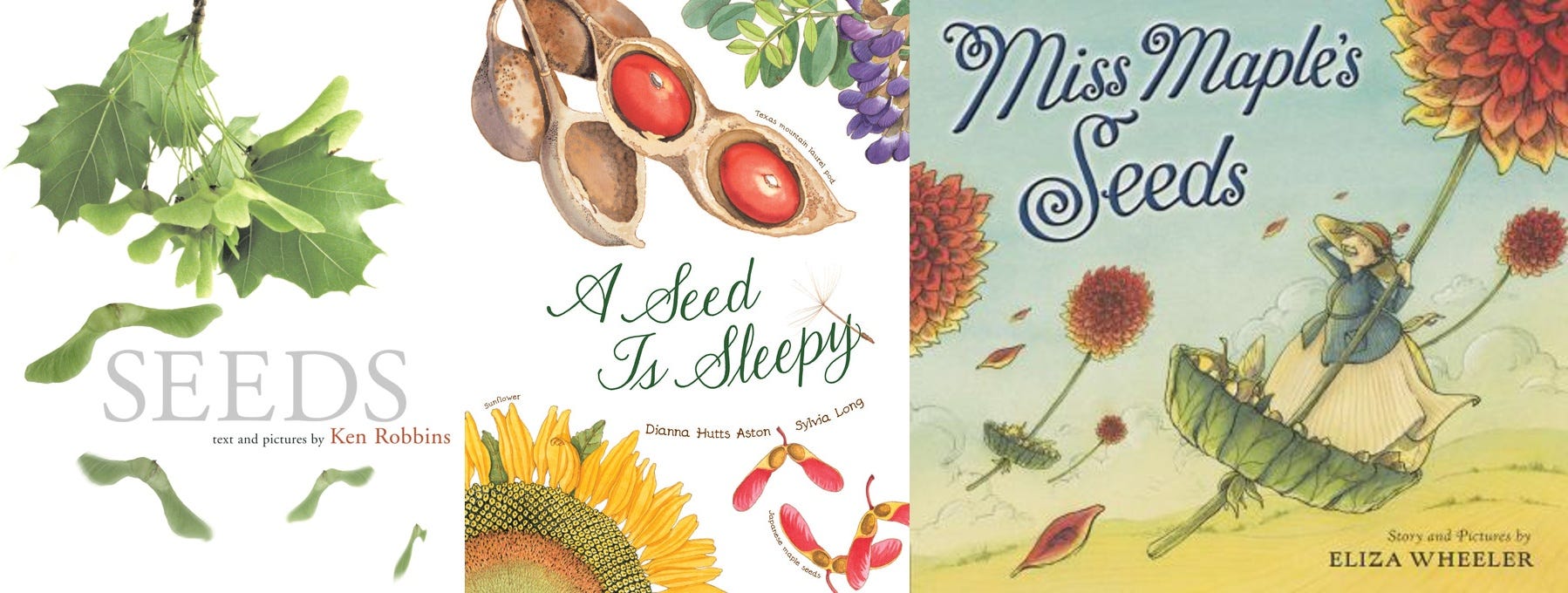
• A Seed Is Sleepy – Dianna Hutts Aston (2007)
• Seeds – Ken Robbins (2005)
• Miss Maple’s Seeds – Eliza Wheeler (2013)
Notes
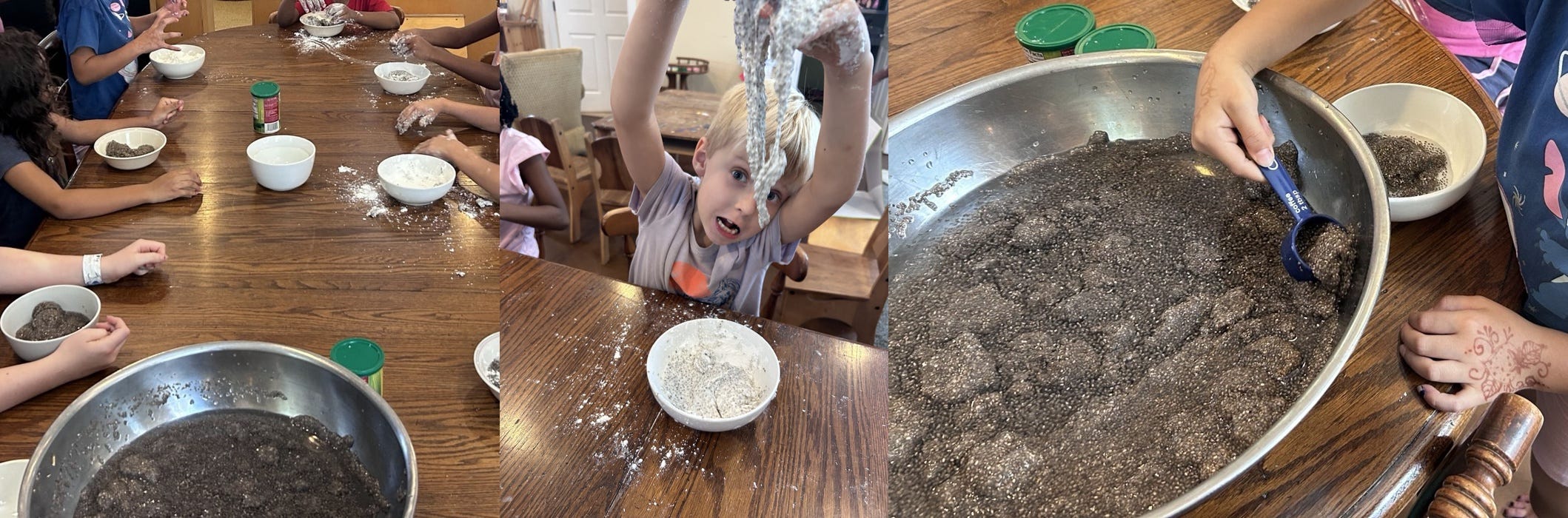
This is a new favorite of mine, and the recipe worked great! Kids love slime, but I really am not a fan of the chemical products involved, the plastic from those products and just a feeling of waste. This recipe feels much better and you can even take the leftover slime and plant it! Here are some fun pics!
Oobleck
Recipe (Free Printable Here)
Ingredients
1 cup cornstarch
½ cup water
Instructions
Add cornstarch to tray.
Slowly add water, mixing until honey-like consistency.
Play!
Books
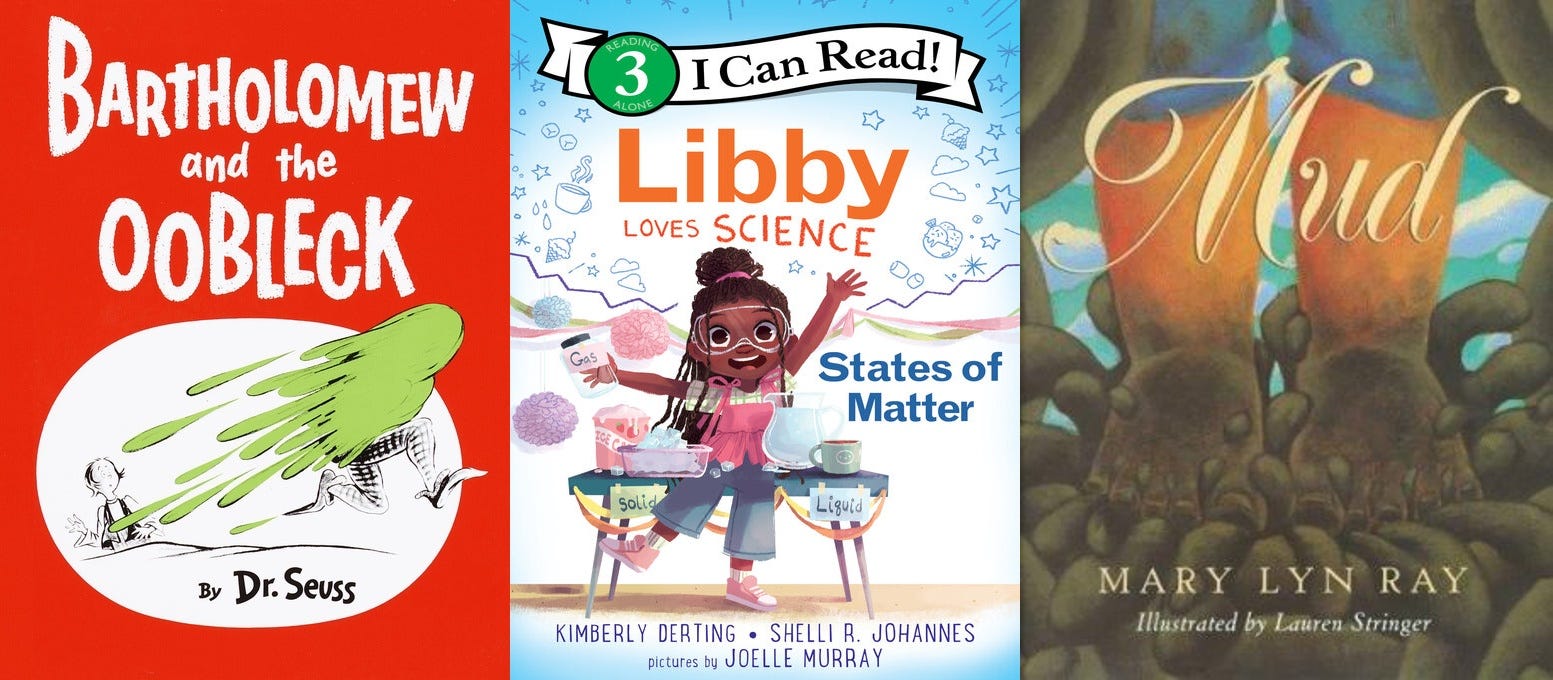
• Bartholomew and the Oobleck – Dr. Seuss (1949)
• Mud – Mary Lyn Ray (1996)
• Libby Loves Science: States of Matter – Kimberly Derting & Shelli R. Johannes (2024)
Notes:
This is an all time favorite that I have been sharing for years. It works in the individual format or in shared. We’ve even made big tubs full for kids to walk in! You can add coloring, but it tends to get on clothes, and I prefer to skip the coloring. The Dr. Seuess book from which the name of the substance comes, is long, super long. The book Mud from Mary Lyn Ray provides a lot of great texture vocabulary.
Cloud Dough
Recipe (Free Printable Here)
Ingredients
1 cup flour
1/8 cup melted coconut oil
Food coloring (optional)
Instructions
Add flour to bowl
Make a crater for oil.
Add oil.
Mix and knead.
Add food color.
Mix and knead.
Play!
Books
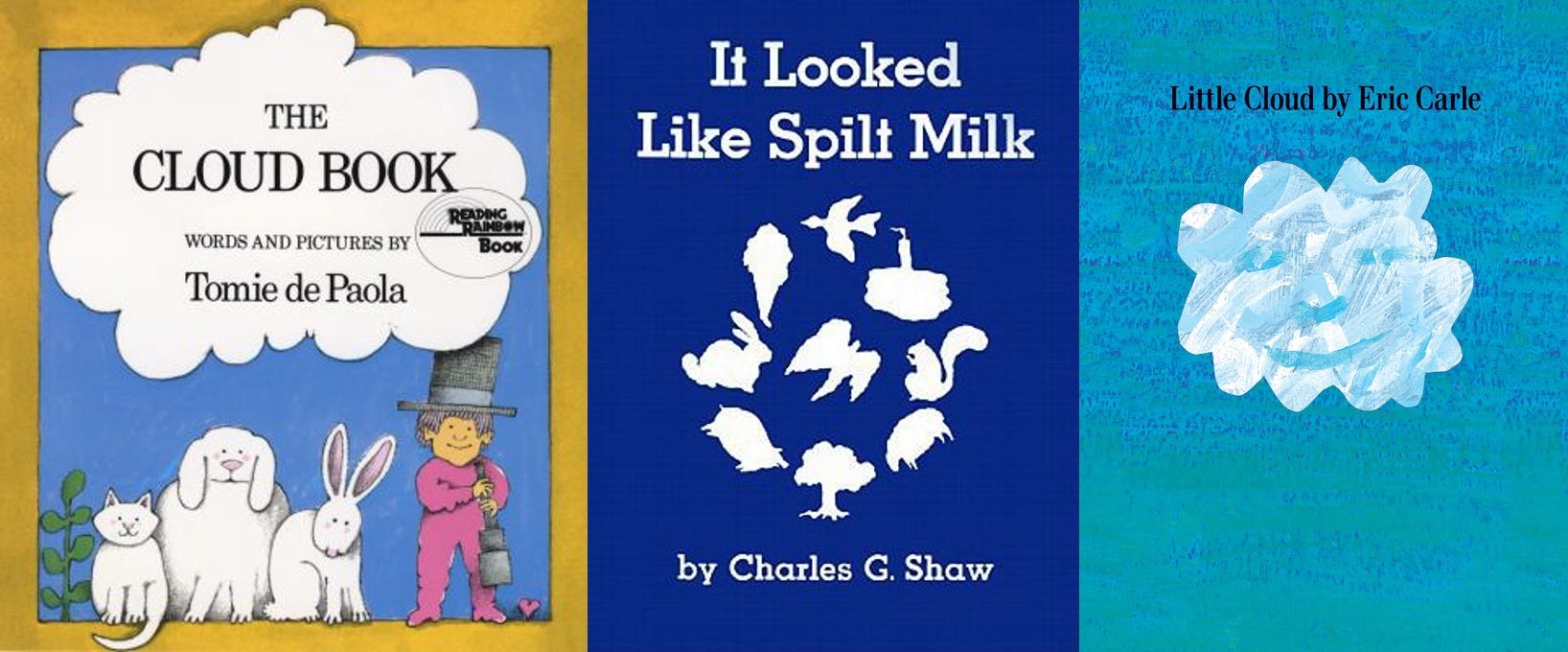
• Little Cloud – Eric Carle (1996)
• It Looked Like Spilt Milk – Charles G. Shaw (1947)
• The Cloud Book – Tomie dePaola (1975)
Notes:
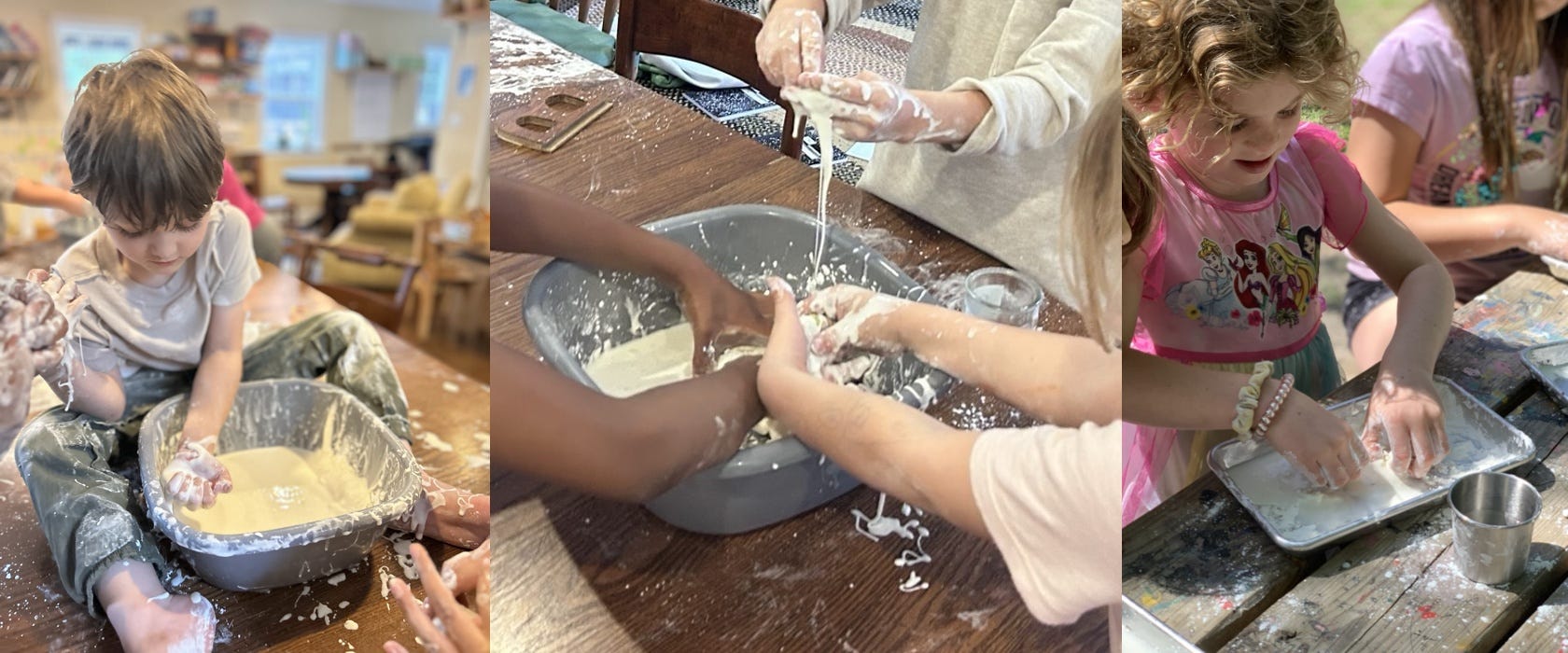
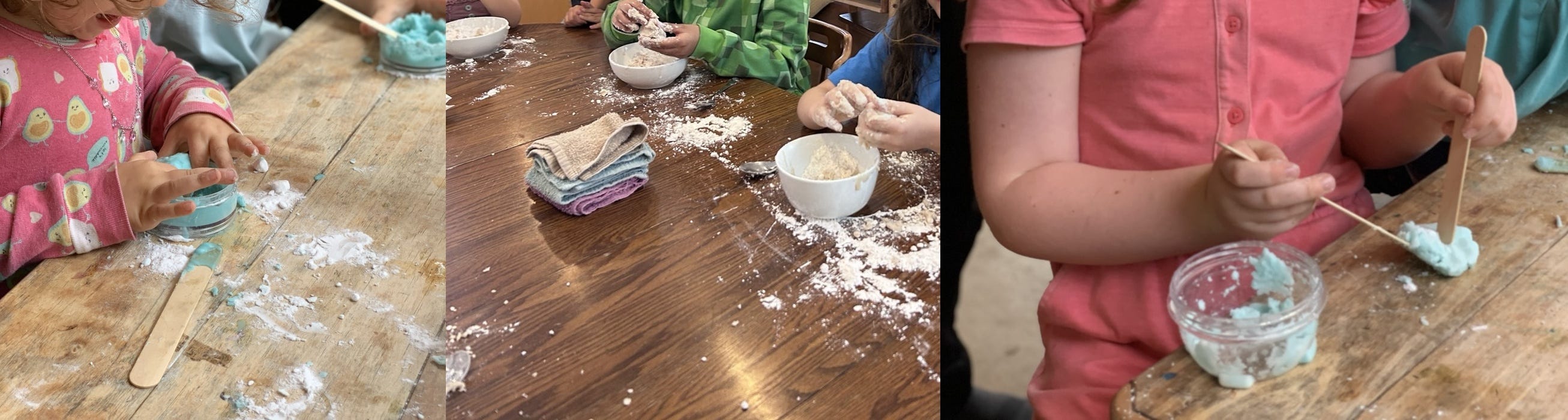
We enjoyed this one, but it was a process in patience. You really had to work the dough good and long for it to come together. It did work though!
Fluffy Foam
Recipe (Free Printable Here)
Ingredients
1 tablespoon dish soap
1/8 cup water
Instructions
Mix dish soap and water in bowl.
Use hand mixer or whisk to beat vigorously for a few minutes.
Play!
Books
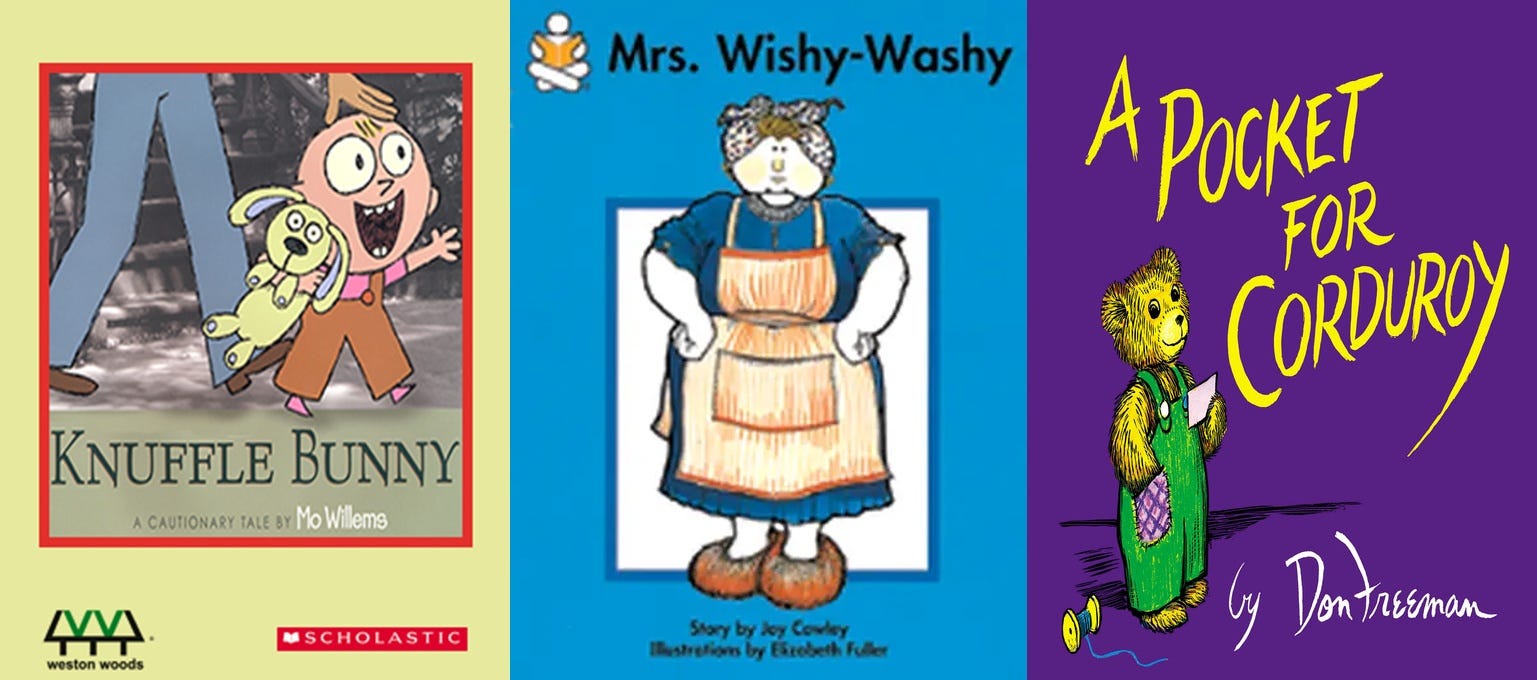
• A Pocket for Corduroy – Don Freeman (1978)
• Knuffle Bunny: A Cautionary Tale – Mo Willems (2004)
• Mrs. Wishy-Washy – Joy Cowley (1980)
Notes
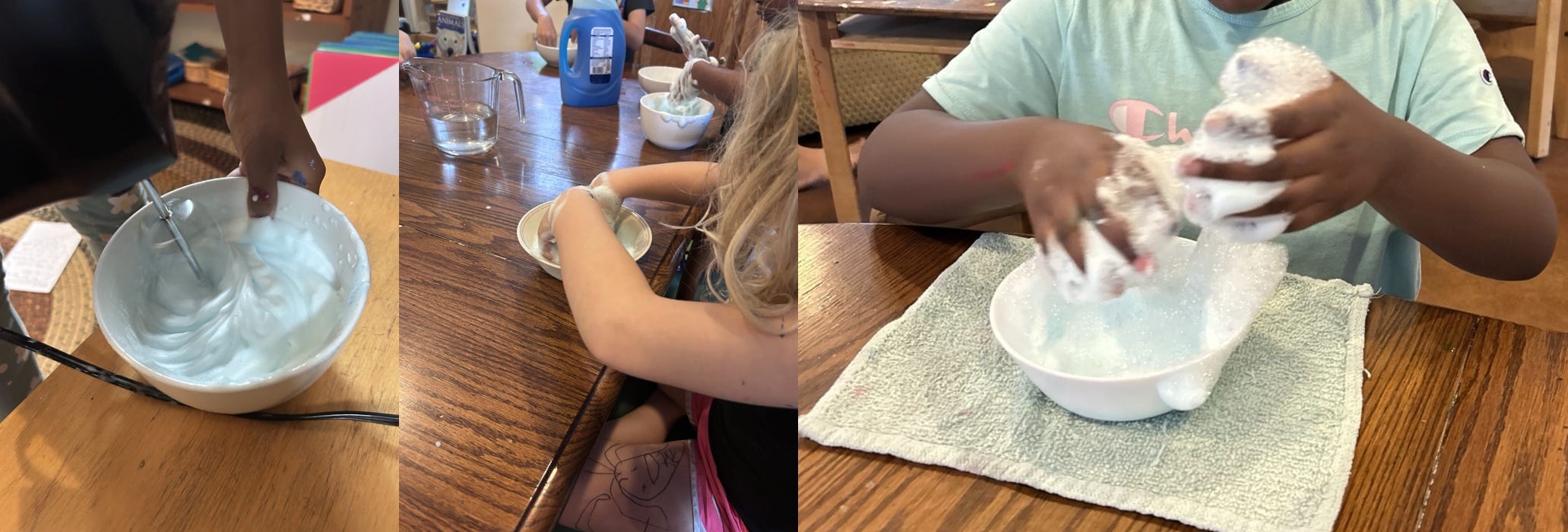
Well this is really pretty simple, but a lot of fun! We used Dawn dish soap, because I know it is the best kind for giant bubble solution, but it would be good to experience with other kinds. Using the electric mixer gives great results, but I would like to try it with rotary hand mixers for a different take.
More on sensory play coming up!